The manufacturing traceability problem
A component supplier ships several lots of machined parts to an automotive customer. Each lot passes inspection, receives quality approval and leaves the plant with a certificate.
Six months later, a gauge used to inspect a critical dimension is found out of tolerance.
The customer asks a simple question: Were any shipped parts accepted on unreliable measurements?
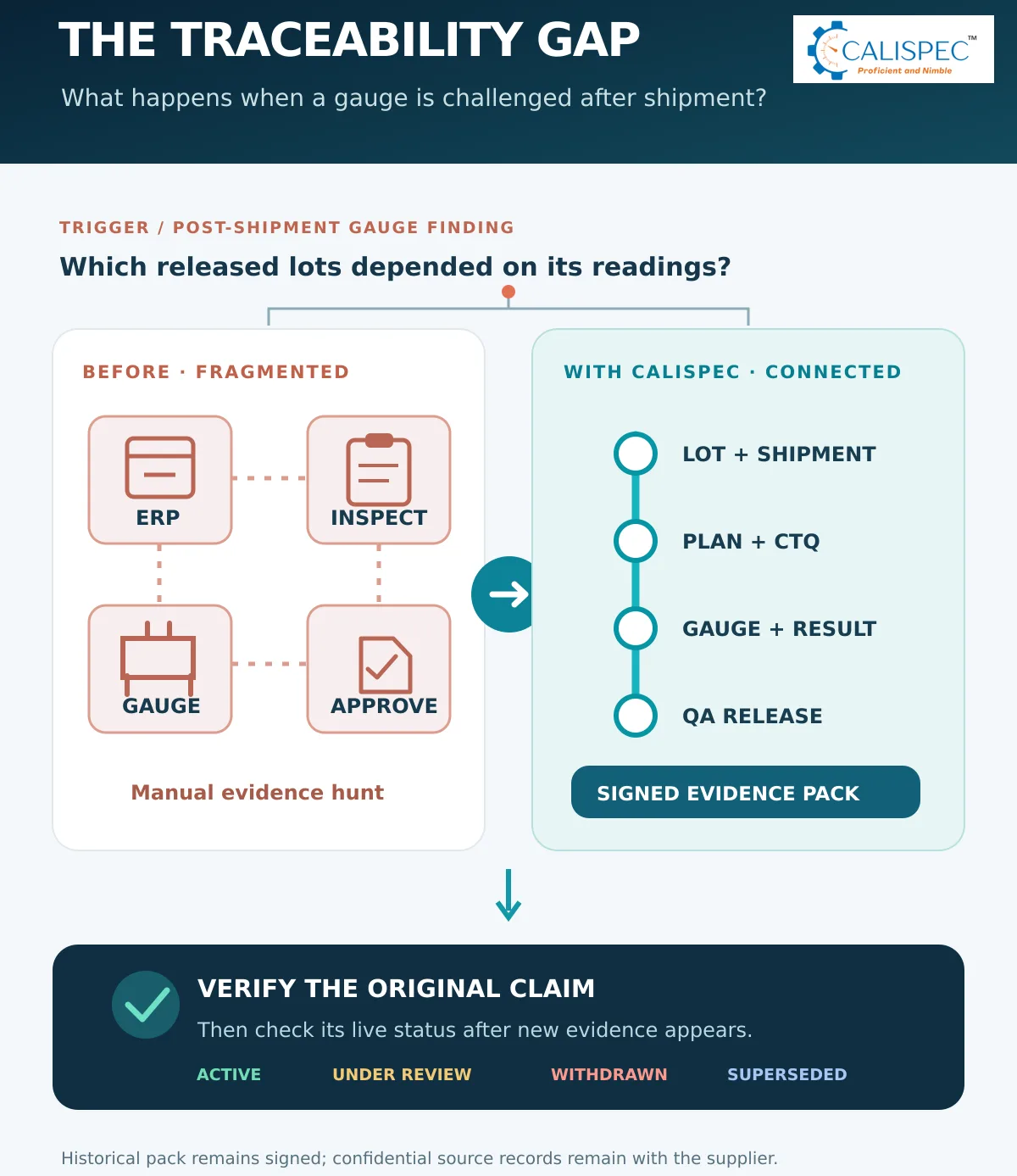
Answering it is far from simple. The ERP holds lot and shipment information. Inspection readings sit in a quality application. Gauge records and calibration certificates are stored elsewhere. The control plan has been revised since the parts were produced. An exception approval may exist only in an email thread.
The supplier has records, but it lacks a readily accessible chain connecting the original measurement to the release decision and the customer shipment. Its team must reconstruct what was true at the time each lot was accepted.
This is a recurring gap in manufacturing quality. Product traceability can show where a lot came from and where it went. It does not always reveal the complete measurement and approval basis for declaring that lot conforming.
A timely direction from NIST
In September 2026, NIST finalized Supply Chain Traceability Principles: A Manufacturing Meta-Framework (NIST IR 8536). It describes how organizations can link and verify events across supply chains while selectively disclosing information and protecting sensitive internal operations.
The report addresses product provenance broadly. For quality teams, it prompts a more specific design question:
Can a customer verify the basis of a shipment’s conformity claim without gaining access to the supplier’s entire quality system?
Calispec’s proposed response is to connect the records behind the decision and issue a controlled Inspection Conformity Evidence Pack.
The Calispec solution: a time capsule for the release decision
For a defined part, lot or shipment, Calispec brings together the evidence used to approve release:
- Part, lot, serial range and shipment identifiers
- Applicable specification, control plan and inspection plan revisions
- Critical characteristics, inspection coverage and sampling basis
- Results and the instruments used to produce them
- Calibration and measurement-system eligibility at the time of inspection
- Exceptions, dispositions and required approvals
- The authorized conformity decision and issue time
The issued pack acts as a time capsule. It preserves the approved basis for the decision as it existed when the product was released. A later change to a control plan, certificate or gauge status cannot silently change that historical record.
The pack states its coverage accurately. If the release decision was based on sampling, it identifies the sampling basis; it does not suggest that every feature of every part was measured.
Verifiable evidence without exposing confidential records
The supplier need not share all its raw readings, complete instrument histories or proprietary process information. Calispec can prepare a customer-specific statement containing the approved claim and the evidence agreed for disclosure.
At issue, the shared files can be listed in a manifest with their SHA-256 hashes. A protected supplier key digitally signs the manifest. The pack can then be delivered through a customer portal or an existing service such as Zoho WorkDrive or Dropbox or a custom document management system.
The customer can verify that the downloaded files match what the supplier issued. The signature establishes the integrity and attributed origin of the claim; it does not, by itself, prove that an inspection was performed correctly. That assurance depends on controlled source records, measurement practices and QA approval.
This evidence pack is Calispec’s proposed application of NIST’s linked-event and selective-disclosure principles.
When the gauge is questioned
The time capsule becomes most valuable when the decision is challenged.
In the illustrative scenario, the quality team identifies the gauge and its period of concern. Calispec follows the connected trail:
Gauge → measurement events → inspected characteristics → lots → release decisions → shipments → customers.
The team can identify the evidence packs that relied on measurements from the affected period and mark them under review while it assesses the risk.
Each original signed pack remains intact. Once the investigation is complete, the supplier can document why a claim remains valid, or withdraw it and issue an amended pack. The customer’s verification link shows the pack’s current status—active, under review, withdrawn or superseded—alongside the historical statement.
This distinction matters. A downloaded certificate answers what the supplier declared at release. The live status answers whether the supplier still stands behind that declaration today.
Building on existing ERP traceability
The ERP can remain authoritative for part, lot, order and shipment identities. Calispec connects those identities to control plan execution, inspection results, gauge status, calibration, MSA, exceptions and approvals.
The resulting evidence pack gives a customer a verifiable view of the quality decision, even when supplier and customer use different enterprise platforms. Confidential source records remain under the supplier’s control.
The outcome to target
For a supplier, the goal is to identify the potentially affected population promptly and support a proportionate investigation. For a customer, it is to know which conformity claims still stand and which require review.
Manufacturing traceability should answer more than “Where did this lot go?” It should also answer “Why was it accepted—and does that decision still stand?”