
The acquisition is complete. The quality standards are still operating independently.
Each acquired manufacturer brings experienced teams, established procedures and long-standing customer commitments. Its quality systems may be mature and effective within its own operations.
The challenge begins when the group transfers production, shares gauges and fixtures, consolidates suppliers or compares performance.
Suddenly, familiar terms—approved, calibrated, MSA complete, action closed—carry different meanings.
Some differences reflect legitimate engineering and customer requirements. Others are inherited practices whose implications have never been assessed across the group.
The exposure begins when those differences are treated as equivalent.
Same Part. Different Verdicts.
Two plants may inspect similar components using different sampling plans, measurement methods, inspection frequencies and reaction rules.
Before transferring production, the group must determine which controls apply and whether the receiving plant can demonstrate equivalent assurance.
Available capacity alone does not establish quality readiness. Unreconciled practices can lead to different acceptance decisions for the same characteristic.
One Policy. Different Release Decisions.
A corporate policy may require valid calibration before use. Local procedures determine what “valid” means operationally.
One plant releases a gauge after reviewing and accepting calibration results. Another considers the activity complete when the certificate arrives.
Both may report the gauge as current, even though the approval process differs.
The same ambiguity can affect fixture validation, tool reconditioning and corrective-action closure. A shared status label can conceal different levels of scrutiny.
MSA Complete. Fitness Still Unclear.
MSA practices may differ in study selection, part selection, operator participation, acceptance criteria and reassessment triggers.
Application-specific differences can be necessary. The group still needs a common framework for deciding whether a study represents production conditions—and what its findings permit.
A completed study provides limited assurance if a failed result does not lead to a restriction, improvement action or reassessment.
The meaningful question is whether the measurement system is fit for its intended use.
The Asset Moved. Did Its Approval Travel Too?
Sharing gauges, fixtures and tools can improve utilisation. Their suitability depends on the receiving application.
A gauge may face tighter tolerances. A fixture may need validation against another drawing revision. A tool’s remaining usable life may be unclear because usage was recorded differently.
Asset history should travel with the asset. Approval for the new application needs a deliberate decision.
Otherwise, local assumptions become group-wide exposure.
Customer Requirements Do Not Merge.
An acquisition does not remove existing customer obligations.
Inspection, traceability, documentation and approval requirements may legitimately differ between companies. Harmonisation must distinguish those obligations from historical preferences.
Standardising too aggressively can remove a necessary control. Preserving every local practice can leave the group with permanent fragmentation.
The task is to establish a common baseline with explicit, justified variations.
One Supplier. Fragmented Risk.
Several group companies may use the same supplier under different local codes, audit criteria and approval scopes.
An unresolved finding in one business may remain invisible to another that is increasing its dependency on that supplier. Approval for one supplier site or product family may also be interpreted too broadly.
Purchasing consolidation needs a corresponding view of quality exposure—connected across companies, with the affected scope preserved.
Green Dashboards. Unreliable Comparisons.
Calibration compliance, MSA coverage and action closure can use different denominators, exclusions and completion rules.
The percentages look comparable. Their meaning is not.
A plant applying stricter controls may appear to perform worse than one reporting against a narrower scope. Leadership can then direct attention and investment toward the wrong priorities.
Common reporting requires common definitions and accessible evidence.
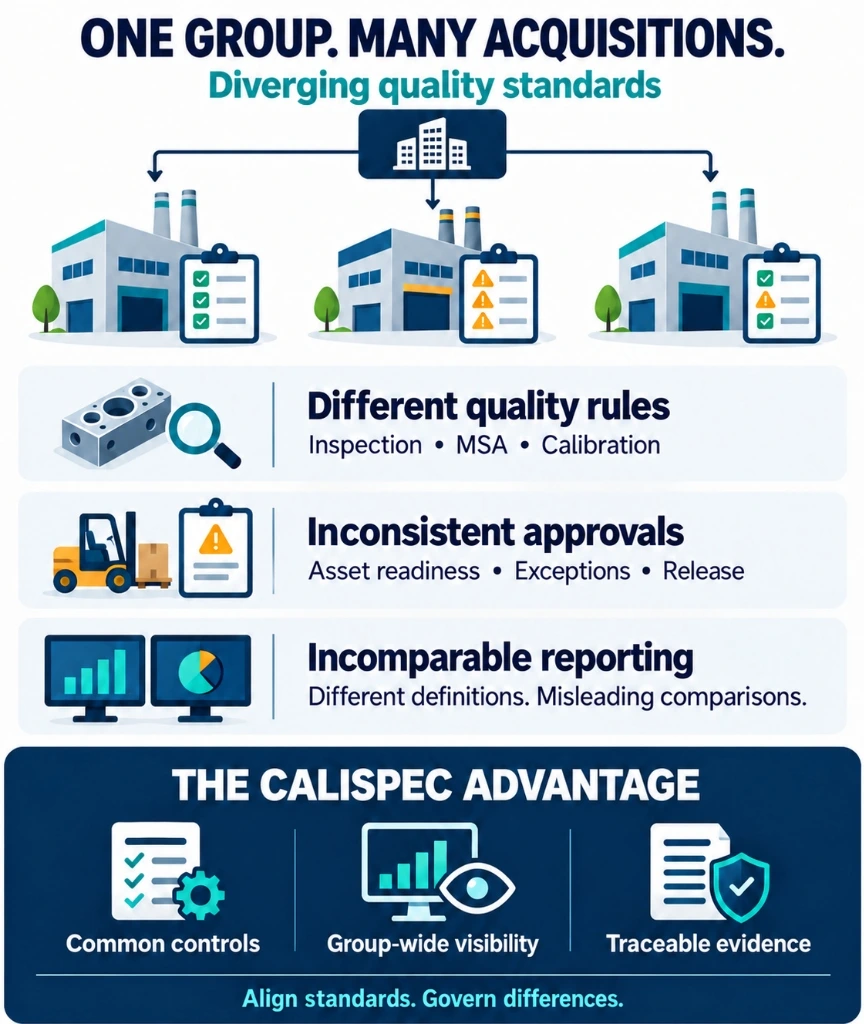
The Calispec Advantage: Make Divergence Visible and Governable.
For manufacturers growing through acquisitions, Calispec can help establish a common governance foundation across companies by connecting measurement assets, quality controls and supporting evidence.
The enterprise value lies in enabling:
-
Common controls: Align status definitions, evidence requirements and approval rules while preserving justified local variations.
-
Group-wide asset visibility: Connect gauges, fixtures and tools with their lifecycle history, readiness and restrictions.
-
Comparable measurement assurance: Relate calibration and MSA evidence to intended applications and expose unresolved gaps.
-
Controlled execution: Connect control plans, inspection requirements and revisions to the relevant company, plant and customer context.
-
Traceable oversight: Follow a group metric or supplier finding to its scope, responsible team and supporting records.
A practical starting point is the exposure that crosses company boundaries: shared assets, transferred production, common suppliers and critical measurement systems. Delivery can then expand through the relevant modules and integrations.
Acquisitions bring manufacturing businesses together. Quality governance establishes a common basis for trusting their decisions.